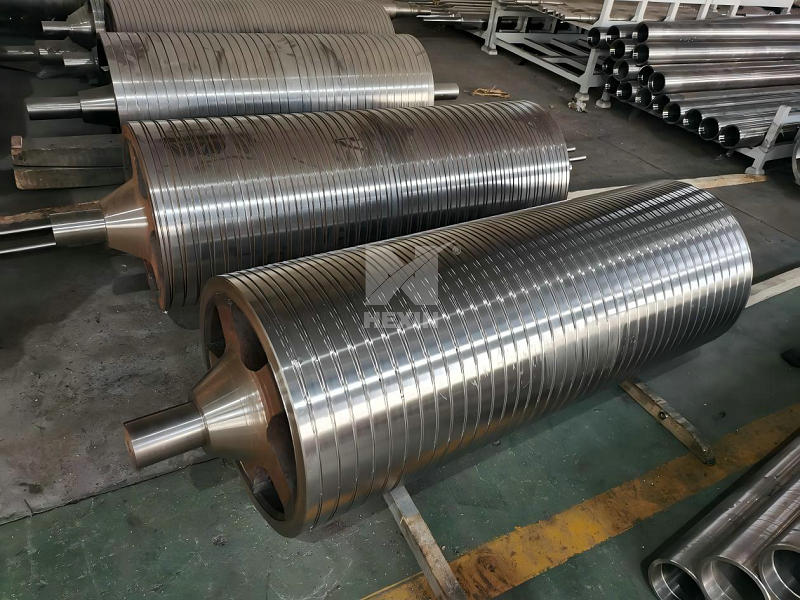
Effective measures to extend the service life of sinking rol
Product Category:Industry NewsPrice:Negotiation

Domestic and international scholars have conducted extensive research on the sinking roller assemblies in cold-rolled hot-dip galvanizing lines, focusing on materials and surface spraying technologies. Through experiments and various surface treatment methods, they have proposed effective measures to extend the service life of sinking rollers. Qingdao Hexin Machinery Co., Ltd. summarized their findings as follows:
Fan Zishuan of the University of Science and Technology Beijing began by examining the actual operating conditions and corrosion mechanisms of sinking rollers in galvanizing pots. He then provided a comprehensive overview of domestic and international zinc corrosion-resistant materials and surface treatment technologies. He pointed out that thermal spray coatings can effectively mitigate liquid zinc corrosion and that high-temperature-resistant inorganic sealants can improve the corrosion resistance of thermal spray coatings to liquid zinc. Finally, he proposed future research directions for sinking roller resistance to liquid zinc corrosion.
Liu Chunfu and He Tongzheng of the Panzhihua Iron and Steel Research Institute proposed that slag buildup on the sinking roller surface is the primary factor affecting the surface quality of hot-dip galvanized products. They also explained that 316L stainless steel cannot completely overcome the problem of slag buildup on the sinking roller surface, necessitating improvements to the sinking roller material. Therefore, improving the coating material properties and spraying process to enhance the quality of the sinking roller assembly and roller surface will ultimately improve the surface quality of galvanized products. Li Gang, Hu Mimi, and others explained the various causes of sink roll marks, including the material of the sink roll, the condition of the roll surface, the shape and size of the roll surface grooves, the temperature of the liquid zinc, and the composition of the liquid zinc. These factors influence the occurrence of sink roll marks to varying degrees and can significantly increase the severity of sink roll defects. They proposed that during hot-dip galvanizing production, meticulous equipment management in the zinc pot area and effective and strict process management are essential to prevent sink roll marks and other defects.
Li Jianjun and Sun Weiquan improved and innovated the bearing seats for the zinc pot sink rolls in hot-dip galvanizing strip lines. They analyzed and compared five different bearing seat structures and determined that the U-groove taper pin connection design offers the lowest production and maintenance costs in field use.
Tong Ganbo, Peng Jun, and others proposed that the use of a lead-core sunken roller assembly can significantly improve the load conditions on the sliding bearing at the roll neck, including the peak support force and the effective surface area, thereby effectively extending its service life. They also demonstrated that the use of a lead-core sunken roller assembly can reduce strip vibration, thereby improving line stability and enhancing the quality of galvanized products.
Tian Kai and others from Beijing University of Technology studied the zinc corrosion resistance of galvanized sunken rollers by optimizing the surface grooves, assessing their corrosion and wear resistance, and the wear and corrosion resistance of the sleeves, as well as post-treatment of the coating. The results demonstrated that the coated sunken roller system produced using a supersonic spraying process exhibited superior wear and corrosion resistance. Furthermore, the ceramic sleeves at both ends of the sunken rollers performed better than high-chromium and solid stellite alloys, and exhibited better wear and corrosion resistance than 316L sleeves.
Wan Weiwei, Shen Jie, and others added borides and carbides to CoCrMo alloys, CoCrW alloys, iron-based alloys, and nickel-based alloys, and used plasma spray welding (PTA) to deposit various coatings on the sleeves of hot-dip galvanized sinker rolls. The results demonstrate that PTA spray welding is a viable method for depositing thick, zinc-corrosion-resistant coatings.
Based on an analysis of the material performance requirements under the operating conditions associated with the failure mechanisms of sinker roll sleeves in hot-dip galvanizing mills, Sun Huande of Baosteel Research Institute selected six materials for zinc immersion testing, focusing on operating wear tests on three of them. Ultimately, two materials were selected for sleeves produced for field testing. The results showed that sleeves made from hot-work die steel H11 (4Cr5MoVS) and high-speed steel M2 (W6Mo5Cr4V2) had service lives doubled and tripled, respectively. It is suggested that increasing the anodizing content of H11 (4Cr5MoVS) to 0.5%-0.6% would make it more suitable for the sleeve's operating conditions.