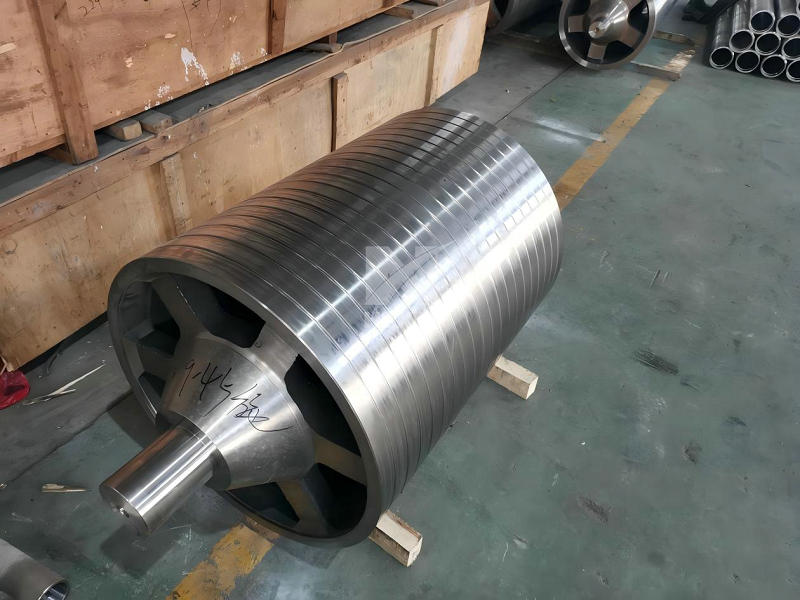
Minor issues, such as scratches, can sometimes occur during sink roll production. What causes these issues? What are the influencing factors?
Hexin believes that many factors generally contribute. For example, in terms of equipment, the following are common reasons:
1. The influence of the sinker roll's deadweight. From a dynamics perspective, another important factor affecting sinker roll transmission is the deadweight of the roll. Under normal production conditions, the sinker roll is affected by the normal pressure of the strip, the friction between the strip and the sinker roll, the forces between the strip and the bearing seat, and its own deadweight. By combining and decomposing these four forces, we can see that the resultant force can be decomposed into radial normal pressure and radial tangential force. The radial tangential force is the driving force behind the sinker roll's rotation, and its magnitude directly affects its rotation.
2. Sinking roller assembly structural design requirements: The design of the sinking roller assembly must ensure axial fixation to prevent axial slippage during rotation. This is particularly true for strips with unpredictable shapes, such as wedges or strips with uneven thicknesses. When the sinking roller contacts the strip, uneven force between the strip and the sinking roller can easily cause the strip to deviate, leading to axial slippage on the sinking roller and resulting in scratches on the sinking roller. The clearance between the sinking roller bearing and the bearing seat should be kept as small as possible; excessive clearance can easily cause radial runout of the sinking roller.
3. Regarding the mechanical structure of the sinking roller assembly, the type of grooves on the sinking roller surface should be a primary consideration to maximize friction. This is due to two factors. First, zinc is a heavy metal, and its molten zinc has poor fluidity and high viscosity. During the high-speed movement of the strip and the sinker roll, a thin film of molten zinc easily forms between the strip and the sinker roll, providing a lubricating effect and reducing the transmission friction between the strip and the sinker roll, which can easily cause scratches on the sinker roll. Therefore, the grooves must facilitate the flow of molten zinc between the strip and the sinker roll to prevent the formation of a sliding film. Second, the grooves on the sinker roll surface must be designed from a mechanical perspective to ensure optimal load conditions between the sinker roll and the strip, maximizing transmission friction. Therefore, these two factors must be considered when designing the grooves on the sinker roll surface.
4. Roller surface material requirements are also an influencing factor. Due to the special working position of the sinker roll, the material of the sinker roll surface must meet three requirements: 1. corrosion resistance, 2. hardness, and 3. roughness.