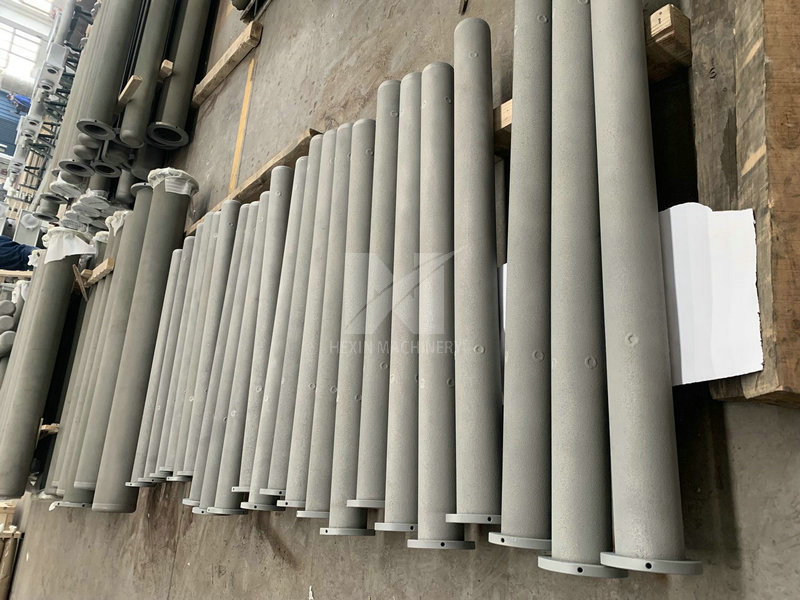
The Importance and Advantages of Centrifugal Casting in Radi
Product Category:Industry NewsPrice:Negotiation

The Importance and Advantages of Centrifugal Casting in Radiant Tube Production
Hexin specializes in the production of industrial furnace components, including gas-fired radiant tubes, electric-heated radiant tubes, and supporting tube sheets and tube supports. We have many years of experience in producing heat-resistant steels, such as 1.4848 and 1.4852. We have established production processes including centrifugal casting, precision casting, static casting, and finishing.
I. Overview of Centrifugal Casting
Centrifugal casting utilizes the centrifugal force generated by a rotating mold to uniformly distribute molten metal along the mold walls. This process is suitable for producing cylindrical, annular, or axisymmetric parts with high density, excellent mechanical properties, and good surface quality. Centrifugal casting demonstrates significant technical and economic advantages in the production of high-temperature and high-pressure components such as radiant tubes.
II. The Importance of Centrifugal Casting in Radiant Tube Production
Radiant tubes are core components of industrial furnaces, subject to long-term exposure to high temperatures, corrosion, and thermal cycling loads. These requirements place extremely high demands on the material's heat resistance, creep resistance, and airtightness. The importance of centrifugal casting in radiant tube manufacturing is reflected in the following aspects:
1. Material Property Optimization
Centrifugal force causes impurities and gases in the molten metal to converge on the inner surface of the casting, forming a dense, high-purity metal layer on the outer surface, significantly improving the radiant tube's high-temperature and corrosion resistance. For example, centrifugally cast HK40 (25Cr-20Ni) or HP-Nb (25Cr-35Ni-Nb) alloy radiant tubes have a service life exceeding 30% compared to statically cast products.
2. Microstructural Uniformity
Centrifugal force promotes directional solidification of the molten metal, resulting in refined and uniform grain distribution, reducing defects such as shrinkage cavities and porosity, and resulting in significantly superior wall thickness consistency and mechanical strength compared to conventional sand casting.
3. Production Efficiency and Cost-Effectiveness
Centrifugal casting can form hollow tubes in a single pass, reducing subsequent machining efforts. With material utilization rates exceeding 90%, it is suitable for mass production and reduces manufacturing costs. III. Core Advantages of Centrifugal Casting in Radiant Tube Production
1. High Density and Low Defect Rate
Centrifugal force continuously feeds the molten metal during solidification, resulting in castings with densities approaching those of forged parts and porosity below 1%, significantly improving the tube's resistance to carburization and oxidation at high temperatures.
2. Composite Material Viability
Centrifugal casting can produce bimetallic composite tubes (e.g., an inner layer of corrosion-resistant alloy and an outer layer of high-strength steel), balancing performance and cost to meet specialized operating requirements.
3. Excellent Surface Quality
Rotating the mold ensures a close fit between the molten metal and the die, resulting in a surface finish of Ra 6.3-12.5 μm, reducing the need for subsequent polishing.