


Application of Furnace Rollers in the Metallurgical Industry
Product Category:Industry NewsPrice:Negotiation

Application of Furnace Rollers in the Metallurgical Industry
Furnace rollers are essential processing equipment in the steel plate smelting process. To meet production requirements, they also meet high performance requirements. Furnace rollers are typical centrifugally cast pipe fittings and are a key component in metallurgical equipment for supporting and transporting slabs. They are widely used in continuous casting and rolling production lines for steel plates.
During the rolling process, the slabs must first be continuously and stably heated in a heating furnace to a rolling temperature of 1050-1150°C. The furnace rollers provide stable support for the slabs, ensuring smooth and even conveying. Because the middle section of the furnace rollers is installed directly in the slab calcining furnace, furnace gas temperatures reach approximately 1150°C during production. Therefore, furnace rollers are typically manufactured from high-temperature alloys such as ZG45Cr28Ni48W5Si2. Furthermore, because the center support portion of the hearth roller is mounted directly inside the furnace, while the cone and bearing support are mounted inside the furnace wall and outside the forging furnace, respectively, the temperature gradient between different parts of the hearth roller is significant. Therefore, the hearth roller is typically welded together by the cylinder, cone, and shaft. To minimize burn damage to the inner surface of the cone, a heat shield is designed inside the cone. To ensure smooth conveying of high-temperature slabs, the roller shaft must be non-deformed and the outer roller ring must be heat-resistant and wear-resistant.
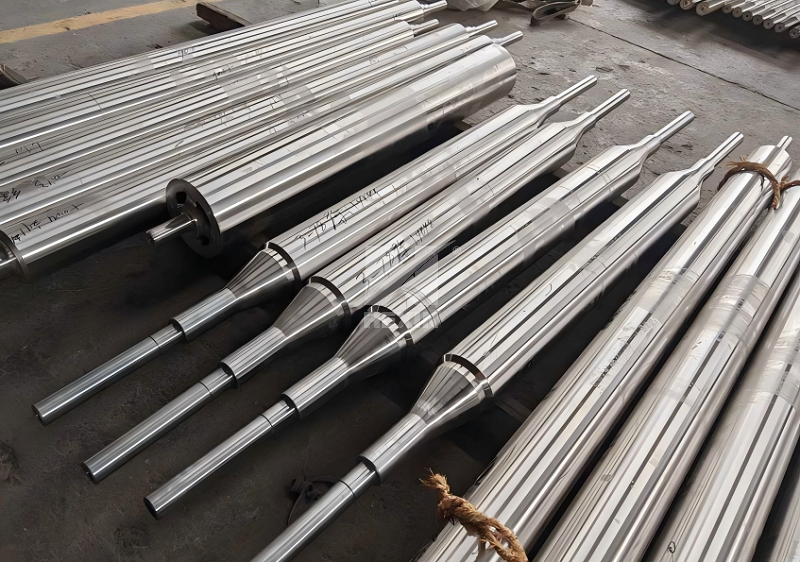
This type of hearth roller is typically produced using centrifugal casting, the cone using static casting, and the shaft head machined from forged material. Machining and manufacturing is the core of the hearth roller manufacturing process. This stage requires precise machining and assembly according to the design drawings. During machining, the following points should be noted:
1. Strictly control machining accuracy to ensure that the size and shape of the hearth roller meet design requirements;
2. Use appropriate machining methods and process parameters to avoid excessive heat and stress that could affect the performance of the hearth roller;
3. Perform quality inspection and testing on the finished hearth roller to ensure it meets operational requirements.