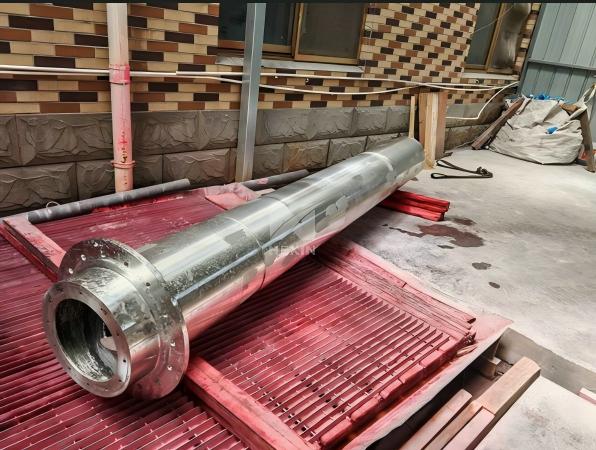
Brief Introduction to the Manufacturing Process of Spiral Fu
Product Category:Industry NewsPrice:Negotiation

Our company's spiral furnaces are mainly manufactured using the following process: integral/segmented casting (heat-resistant steel, wear-resistant, resistant to atmospheric corrosion). Applicable operating conditions: small to medium-sized rotary spiral furnaces operating at high temperatures of 1000–1250℃, carburizing/ammonia decomposition atmospheres, and high abrasion.
1. Commonly Used Casting Materials
ZG35Cr24Ni7SiN: Wear-resistant and heat-resistant at 1100℃, resistant to thermal fatigue
ZG3Cr18Mn12Si2N: Nickel-saving type, 900–1050℃
High Chromium Cast Iron KmTBCr20/Cr26: Strong wear resistance, high hardness
2. Process Route (Taking “Segmented Casting + Welding” as an example)
(1) Model and Process Design
3D Modeling: Integrated modeling of cylinder + inner spiral guide rib
Casting Process: ProCAST simulation → Determine the positions of gate, riser, and chills
Parting: Parting in half along the axial direction at 180°, or segmented radially (each segment 1–2m)
Spiral Guide Ribs: Cast as a whole with the cylinder, without subsequent welding; large rounded corners (R15–R25) at the root of the guide rib to prevent cracking
(2) Molding (Resin Sand / Lost Foam)
Resin Sand Molding (Mainstream)
Wooden Mold / Aluminum Mold → Resin sand molding and core making (inner hole + spiral surface sand core)
Sand core: 3D printed sand core for spiral surface, high precision and easy to form
Lost foam (EPS)
Integral molding of white foam mold → Apply refractory coating → Dry sand compaction → Negative pressure casting
(3) Melting and casting
Medium frequency electric furnace melting → Temperature control: 1580–1620℃ (heat resistant steel)
Gating system: Bottom pouring + annular horizontal runner + spiral surface dispersed inner gate, to prevent cold shut and slag inclusion
Riser: Exposed risers are set at the top of the spiral and the flange to compensate for shrinkage
Pouring speed: Stable and uniform speed, ≤0.5m/s, to prevent erosion of sand core
(4) Cooling and sand cleaning
Heating and slow cooling (24–48h) → Sand cleaning → Cut off the risers and gating → Surface cleaning
(5) Heat treatment (critical)
Annealing / Normalizing: Heating at 850–950℃ → Eliminate casting stress and homogenize the structure. High-temperature section castings: Stabilization treatment (900℃×4h) to prevent deformation during use. (6) Machining and assembly welding. Rough and fine turning of the flanges at both ends and the outer circle → Assembly of the coaxiality of the segmented cylinder → Circumferential welding (heat-resistant steel welding wire) → Post-weld flaw detection → Overall trial operation. 3. Advantages and disadvantages of integral casting vs. segmented casting: Integral casting (small furnace, ≤φ1200×3000) Advantages: No weld seam, good integrity, strong thermal shock resistance Disadvantages: Large mold, high casting difficulty, easy deformation, difficult transportation Segmented casting (medium furnace, φ1200–2500, length 3–8m) Advantages: Easy to cast, small deformation, convenient transportation, replaceable segments Disadvantages: There is a circumferential weld seam, and welding and heat treatment need to be strictly controlled. 4. How to choose the process: welded structure or casting structure? Temperature < 850℃, normal atmosphere, small to medium batch production: Choose rolled steel plate + welded guide ribs (cheap, fast, easy to repair). Temperature ≥ 900℃, protective/carburizing atmosphere, strong wear, long service life: Choose heat-resistant steel segmented casting + integral cast guide ribs (crack-resistant, deformation-resistant, long service life).